

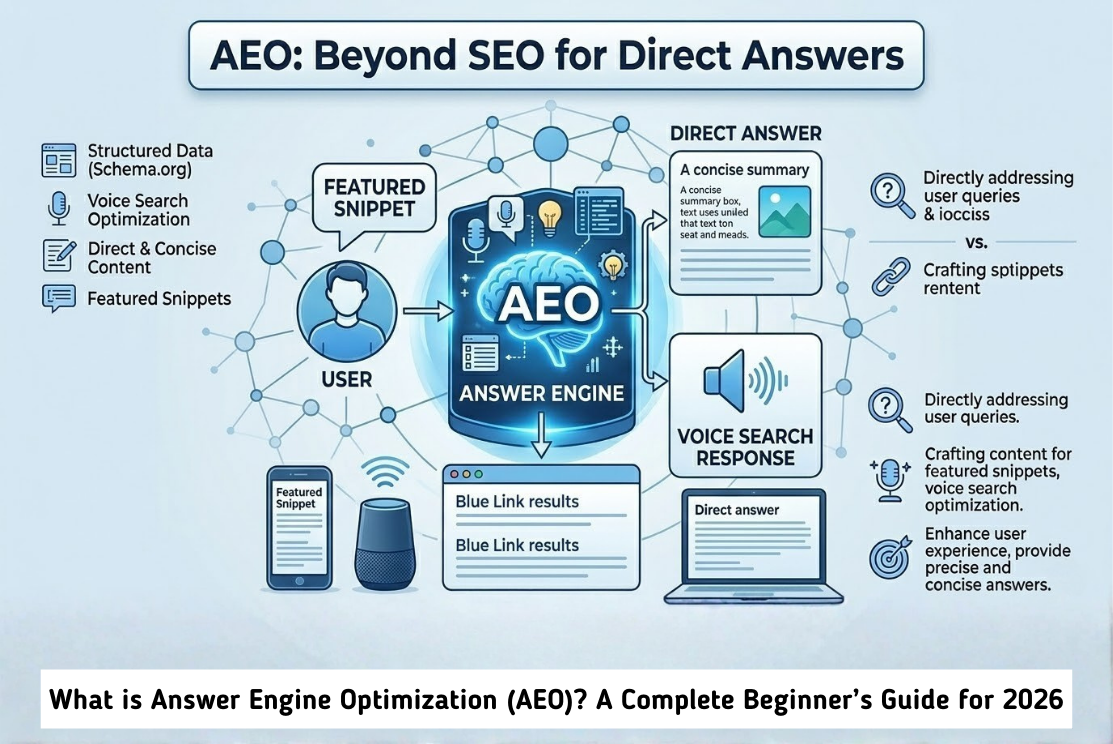
The way people search has changed forever. AI-powered tools like ChatGPT, Google’s AI Overviews, and Perplexity now answer questions directly no clicking required. If your content isn’t optimized for these platforms, you’re already invisible to millions of searchers. That’s where Answer Engine Optimization (AEO) comes in.
In this guide, you’ll learn exactly what AEO is, how it differs from traditional SEO, and the top strategies to get your content cited by AI engines in 2026.
What Is Answer Engine Optimization (AEO)?
Answer Engine Optimization (AEO) is the process of structuring your content so that AI-powered platforms such as Google AI Overviews, ChatGPT, Perplexity, Siri, and Alexa can extract and present it as a direct answer to a user’s query.
Unlike traditional SEO, which aims to rank your page in a list of results, AEO aims to make your content the answer the single authoritative response that AI engines quote or display without requiring users to visit your website.
Why AEO Matters in 2026
Search behavior has shifted dramatically. Users today ask full conversational questions like “What’s the best way to file taxes as a freelancer?” not short keyword strings. AI engines are built to answer these queries instantly and directly.
Here’s why AEO matters right now:
- 58% of searches now end with zero clicks due to AI-generated answers
- Voice search has grown significantly, with users expecting complete spoken answers
- AI Overviews now appear on the majority of informational Google searches
- Brands cited in AI answers receive 3× more trust than those in traditional organic links
If your content is not structured to be understood and cited by AI platforms, you are losing visibility, traffic, and authority to competitors who are.
AEO vs. SEO: What’s the Difference?
AEO and SEO are complementary strategies, not competing ones. Think of SEO as getting people to your website, and AEO as making your content trustworthy enough that AI engines quote it directly.
Goal
SEO: Rank on search result pages.
AEO: Be cited as the direct answer.
Format
SEO: Long-form content and backlinks.
AEO: Concise, structured Q&A format.
Target Platform
SEO: Google and Bing SERPs.
AEO: AI Overviews, ChatGPT, Perplexity, and voice assistants.
Key Signals
SEO: PageRank, keywords, backlinks.
AEO: Clarity, authority, and schema markup.
The bottom line: a strong AEO strategy naturally improves your SEO too.
How Answer Engines Work
Answer engines use Natural Language Processing (NLP) and large language models to scan billions of web pages and find the best answer to any query. They look for:
- Clear, direct answers placed near the top of each page or section
- Structured data and schema markup (FAQ, HowTo, Article schemas)
- E-E-A-T signals Experience, Expertise, Authoritativeness, Trustworthiness
- Question-based H2 and H3 headings
- Concise answer summaries of 40–60 words before expanding into detail
- Mobile-friendly, fast-loading pages
Top 6 AEO Strategies for 2026
Here are the most effective, actionable tactics to optimize your content for answer engines right now.
Strategy 1: Use Question-Based Headings
Structure your H2 and H3 tags as direct questions your audience is asking. Instead of “Benefits of AEO,” write “What are the benefits of Answer Engine Optimization?” This signals to AI engines exactly what each section answers and increases your chances of being featured.
Strategy 2: Implement FAQ Schema Markup
Add JSON-LD FAQ schema to your key pages. In WordPress, plugins like Yoast SEO, RankMath, or Schema Pro make this easy without touching code. FAQ schema helps AI systems identify and extract Q&A pairs directly from your content.
Strategy 3: Write a Concise Answer Blurb First
Open every section with a 40–60 word direct answer before elaborating. AI engines strongly prefer content that answers the question first, then provides supporting detail. This “answer-first” writing structure is the single most impactful AEO change you can make today.
Strategy 4: Build Strong E-E-A-T Signals
AI engines prioritize authoritative, trustworthy sources. Strengthen your E-E-A-T by including detailed author bios, citing reputable external sources, adding publication dates, and earning backlinks from trusted websites in your niche.
Strategy 5: Optimize for Voice Search
Voice queries are longer and more conversational. Write in a natural tone that mirrors how real people speak. Phrases like “how do I,” “what is the best way to,” and “can I” are common voice search triggers worth targeting in your content.
Strategy 6: Target Long-Tail, Conversational Keywords
Use tools like AnswerThePublic, AlsoAsked, or Google’s People Also Ask section to find the exact questions your audience is asking. Build dedicated H2 sections around each question to maximize your AEO coverage.
How to Get Started with AEO Today
You don’t need to rebuild your entire website. Start with these three simple steps:
Step 1: Audit Your Top Pages
Identify your top 5 pages and reformat them with question-based H2 headings and a concise answer summary at the top of each section.
Step 2: Install a Schema Plugin
Use Yoast SEO or RankMath to add FAQ schema to your key content pages in WordPress. This makes your content machine-readable for answer engines.
Step 3: Research Conversational Keywords
Use AnswerThePublic or Google’s People Also Ask box to find real questions your audience is asking, then create dedicated sections answering each one.
Final Thoughts
Answer Engine Optimization is the natural evolution of search. As AI assistants become the primary way people find information, brands that invest in AEO now will earn compounding advantages in visibility, authority, and trust.
A great AEO strategy makes your SEO stronger too. Start small reformat one page, add one FAQ schema block, write one concise answer blurb. The brands winning in AI-powered search in 2026 are the ones who started optimizing for answers not just rankings.
Which AEO strategy will you implement first? Let us know in the comments below!